
Why Europe’s AI Sovereignty Depends on Its Optical Layer
Over the last two years, AI infrastructure has become shorthand for GPUs, accelerators and advanced semiconductor roadmaps. Yet for European telcos and data‑center operators, the less visible optical layer that actually moves data between racks, rows, sites and countries is where sovereignty quietly becomes real.
When European policymakers and operators talk about sovereign AI infrastructure, they usually mean three things. They want the ability to run strategic workloads on infrastructure they control, on European soil or under European jurisdiction. They want to operate and maintain that infrastructure without being dependent on a single foreign vendor or geography. And they want to be able to evolve the platform over time, add capacity, change suppliers, introduce new security controls, without rebuilding everything from scratch.
Those goals are increasingly embedded in European initiatives around AI factories and supercomputing, which explicitly frame AI platforms as strategic capabilities, not just technology upgrades. AI Factories are described by the European Commission as dynamic ecosystems that bring together compute, data and talent to build Europe’s own cutting‑edge AI models. But those factories will only be as sovereign as the components they rely on, starting with the optical layer.
Sovereign AI: more than where the GPUs sit
In day‑to‑day architecture discussions, the interconnect fabric, the optical transceivers and cables that tie accelerators, servers and storage together, often shows up as a line item in a bill of materials. For sovereign AI, it is a lot more than that.
If you cannot source, qualify and replace your optics on your own terms, you have a hidden dependency in one of the most failure‑sensitive layers of your stack. The same is true at national scale: as Europe frames AI clusters and communication systems as critical or even security‑relevant infrastructure, their optical underlay becomes part of the sovereignty equation. Initiatives like the European Quantum Communication Infrastructure (EuroQCI) are already treating secure, fibre‑based connectivity as foundational to digital and national sovereignty.
In other words, you can buy the best accelerators in the world, but if the optics that interconnect them are opaque, geographically concentrated or hard to replace, your AI platform will struggle to be truly sovereign.
What AI‑class networks actually ask of optics
The shift from traditional workloads to AI‑class workloads has three big consequences for the optical layer.
First, AI clusters generate much denser east‑west traffic between GPUs than north‑south traffic between servers and the outside world. That translates into short‑reach, very high‑bandwidth links within and between racks, tight requirements on latency and jitter, and a much higher number of optical links per kilowatt of compute than in a typical enterprise data center. Recent analyses of AI and GenAI infrastructure in EMEA underline how fabric design and interconnect are becoming central bottlenecks.
Second, higher speeds put more pressure on power and thermals. As link rates step through 100G, 400G, 800G and toward 1.6T, optics must support more bandwidth within existing power and cooling envelopes. For European operators facing volatile energy prices and strict sustainability targets, even a few watts per port quickly scale into real limits on how many accelerators you can host.
Third, fabric‑wide reliability has to hold under continuous change. AI clusters evolve quickly: line cards are swapped, fabrics extended, and new module generations introduced while the platform remains in production. That drives strong expectations on interoperability between vendors and generations, robust test and metrology regimes, and the ability to control and audit firmware across fleets of optics for both security and stability.
All of these are optical‑layer issues, and all of them intersect directly with sovereignty.
Where European manufacturing changes the risk profile
For many years, the supply of optical transceivers and sub‑assemblies has been heavily concentrated in a small number of geographies and contract manufacturers. That model was acceptable when optics were “just another component” in a system vendor’s BOM. It looks less convincing when AI clusters depend on tens of thousands of ports in a single site, and when governments are asking for clarity on origin, security and resilience all the way down the stack.
There is now a clear shift in thinking about bringing optical transceiver production back to Europe. Analyses of reshoring highlight benefits that go far beyond tariffs or shipping times: more predictable regulation, alignment with digital‑sovereignty goals, tighter security controls and lower sustainability footprints.
European‑based optical design and manufacturing does not magically solve every problem, but it changes the risk profile in important ways:
Shorter, more transparent supply chains – Having design, manufacturing and test closer to the networks you operate reduces lead times and makes end‑to‑end traceability easier. Operators can audit processes, visit lines and build long‑term collaboration instead of treating optics as anonymous commodities.
Better alignment with critical‑infrastructure requirements – When your optics are designed and produced under European regulation and standards, conversations about critical‑infrastructure requirements and security certification become more straightforward. Local production also makes it easier to align with emerging initiatives like EuroQCI and national AI strategies.
Real leverage in multi‑vendor strategies – A European optics partner that is not tied to a single system vendor gives operators more flexibility in implementing multi‑sourcing strategies without compromising on performance or support. As state‑aid decisions like the EU’s approval of funding for next‑generation transceivers in Italy show, Brussels is willing to back the growth of a diverse European optics ecosystem.
“Made in Europe” at the optical layer is not a slogan; it is a concrete tool for reducing concentration risk in a part of the stack that AI and critical networks rely on every second.
Metrology and automation: sovereignty you can measure
Sovereignty is not only about where something is built, but how it is built.
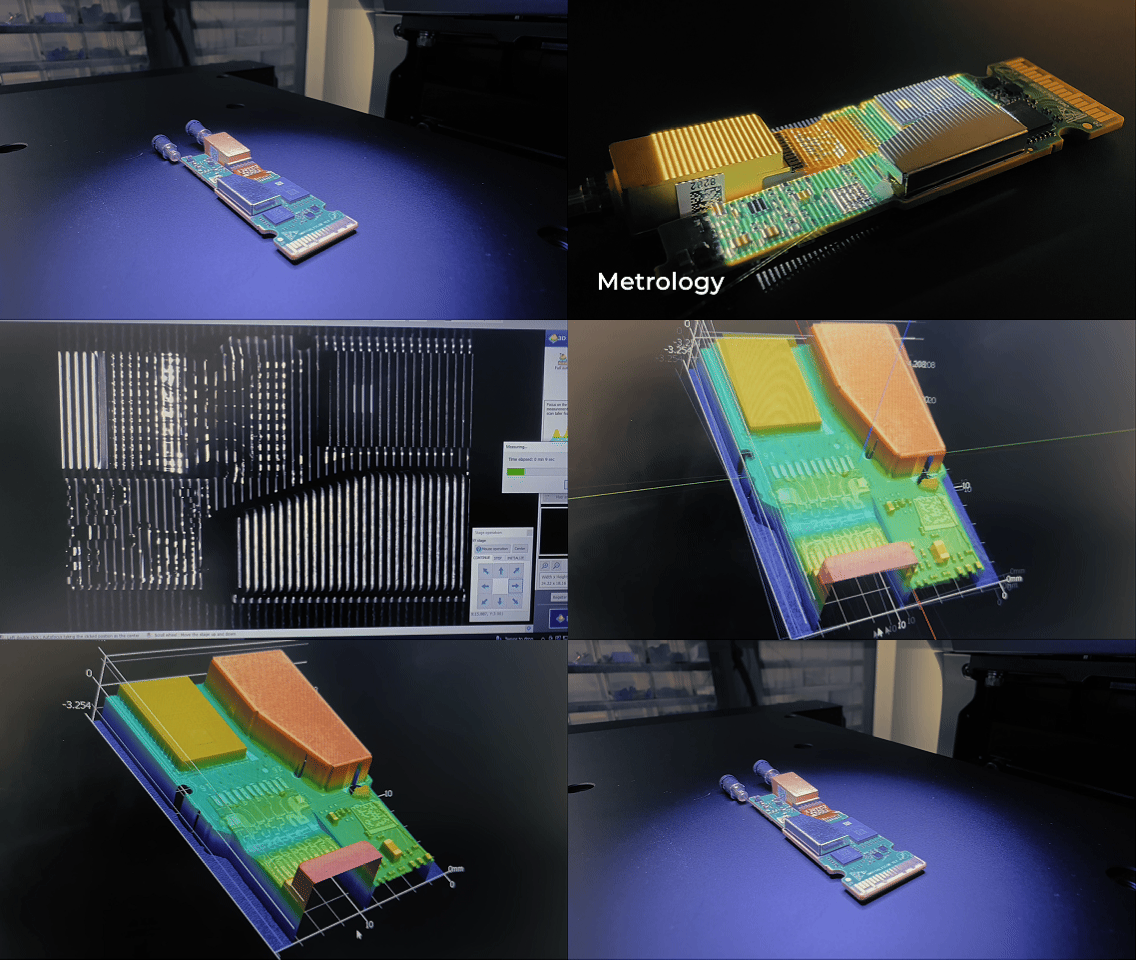
Optical transceivers operate with sub‑micron tolerances on alignment, and tight specifications on wavelength, eye quality and bit‑error rates. Technical guides on pluggable transceivers emphasize how demanding these parameters are and how much careful testing they require. If you cannot measure these accurately and repeatably during production, you cannot guarantee that a module will behave as promised in a dense AI fabric or a national backbone.
This is where metrology and automated production lines become strategic assets. Automated stations can check critical parameters, output power, wavelength, extinction ratio, BER, connector geometry, at multiple steps in the process, not just at final test. That allows early detection of drift and ensures consistent performance across batches.
Equally important is the data that goes with it. When every module is associated with a production and test trace, operators can correlate field behaviour with manufacturing data and use that feedback to tighten SLAs over time. Integrated production and test environments also make it easier to manage firmware versions and configuration profiles at scale, which is essential when optics themselves become part of your security posture.
For European telcos and data‑center operators, the combination of local manufacturing plus deep metrology and automation translates into something that looks very much like operational sovereignty: the ability to understand, trust and, if necessary, switch or replicate the optical components underpinning your networks.
What to ask your optics suppliers
If you are planning AI‑class or otherwise strategic infrastructure, it is worth extending your usual RFP questions to cover the optical layer explicitly. Analyst firms tracking EMEA AI and GenAI infrastructure note that interconnect and supply‑chain resilience are fast becoming board‑level topics.
Consider asking:
Where are the transceivers you are proposing designed, manufactured and tested?
What degree of inline metrology and automated test do you apply, and what data can you share with us?
How do you manage firmware transparency and updates across large fleets of optics?
How many alternative production sites or routes exist if one geography becomes constrained?
What is your roadmap from today’s speeds to 800G and 1.6T, and how do you plan to keep power and thermals under control?
The answers will tell you a lot about how resilient and “sovereign” your future AI and network platforms really are.
The quiet foundation of sovereign AI
AI clusters are increasingly being treated as national assets and as core enablers of Europe’s economic and security ambitions. Strategies like the EU’s Apply AI plan explicitly link AI adoption to technological sovereignty. Telecom networks are likewise expected to serve as strategic infrastructure, hosting everything from sovereign cloud workloads to quantum‑secure communications.
For European operators, sovereignty will be judged not only by where your data sits or where your GPUs are racked, but by whether you can understand, trust and control the components that connect everything together. Getting the optical layer right, through thoughtful design, European manufacturing and rigorous metrology, is one of the most powerful, and most overlooked, ways to make sovereign AI infrastructure real.